
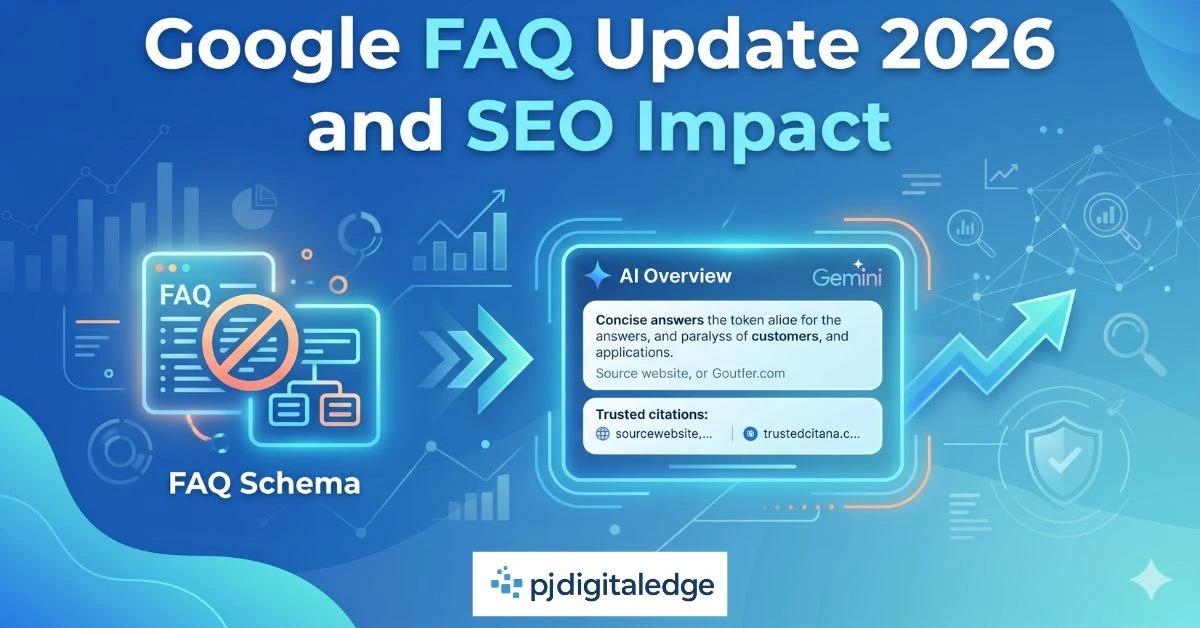
The Google FAQ Update has significantly changed how websites appear in search results. For years, marketers used FAQ rich snippets to increase visibility, improve click-through rates, and occupy more space on Google Search. However, the latest Google Search Update 2026 officially removes FAQ rich results from standard search listings.
This shift reflects Google’s broader transition toward AI-powered search experiences and generative search results. Website owners, bloggers, and SEO professionals now need to rethink how they use structured data and optimize content for modern search behavior.
Understanding how the Google FAQ Update 2026 for SEO works is essential if you want to maintain organic visibility and adapt your SEO strategy for the future.
What Is the Google FAQ Update?
The Google FAQ Update is a major change to how Google handles FAQ structured data in search results. Previously, websites could display expandable FAQ dropdowns beneath their search listings using FAQ schema markup.
Google first limited FAQ rich results in 2023, mainly showing them for trusted government and health websites. In 2026, the feature was fully removed from general search results.
Timeline of the Update
- May 2026: FAQ rich results stopped appearing globally
- June 2026: FAQ reports removed from Search Console
- August 2026: FAQ schema support removed from related Search Console APIs
Although the visual FAQ snippets disappeared, structured data itself still remains important for semantic understanding and AI systems.
Why Google Removed FAQ Rich Results
Google stated that FAQ rich results had become overused across search results. Many websites added unnecessary FAQ sections only to gain additional SERP visibility rather than improve user experience.
The removal also aligns with Google’s growing focus on AI-generated answers and AI Overviews. Instead of showing multiple expandable FAQ dropdowns, Google now prioritizes concise AI-generated summaries directly within search results.
This creates a cleaner mobile experience while allowing AI systems to generate faster and more contextual answers.
How Google FAQ Update Affects SEO Rankings
Many website owners worry that losing FAQ rich snippets could hurt rankings. In reality, the update mainly affects visibility and click behavior rather than core ranking signals.
Reduced Click-Through Rates
One of the biggest effects of the update is reduced SERP visibility. FAQ rich snippets previously occupied more vertical space in search results, helping listings stand out.
Without those dropdowns, websites may experience lower click-through rates, especially on informational searches. This makes optimized title tags and meta descriptions more important than ever.
FAQ Content Still Has SEO Value
Even though FAQ Rich Results are gone, FAQ content itself still matters. Well-structured question-and-answer sections help search engines understand topical depth and user intent.
Google continues to use structured data to interpret page context, relationships, and entities. This means FAQ Schema SEO is still useful from a semantic SEO perspective.
AI Overview Visibility
An interesting development after the Google Search Update 2026 is the growing role of structured data in AI-generated search experiences.
Websites using clean and accurate schema markup may have a better chance of appearing in AI Overviews and AI-generated citations. Structured content is easier for AI systems to interpret and summarize.
Should You Still Use FAQ Schema?
A common question after the update is whether website owners should remove FAQ schema markup.
The practical answer is no.
Using FAQ schema after Google update 2026 still offers indirect SEO benefits, particularly for content organization and AI understanding.
Best Practices Moving Forward
- Keep Existing Schema
If your FAQ markup accurately matches visible page content, there is no reason to remove it.
- Focus on User Intent
Create FAQ sections that answer genuine customer questions instead of targeting snippets only for SEO visibility.
- Maintain Content Accuracy
Ensure the text inside your structured data matches the content users can actually read on the page. Mismatched schema can reduce trust signals.
- Build Topical Authority
Use FAQ content to strengthen expertise around your primary topic and improve E-E-A-T signals.
Adapting Your SEO Strategy After the Update
The removal of FAQ rich snippets signals a larger shift toward AI-driven search optimization. SEO is no longer only about ranking pages but also about helping AI systems understand and cite your content.
- Improve Direct Answer Formatting
Place concise answers directly below question-based headings. Short, clear responses improve readability and AI extraction.
- Use Other Structured Data Types
Instead of relying heavily on FAQ markup, focus on schema types that still generate rich results, such as:
- Product schema
- Review schema
- Video schema
- Recipe schema
- Organization schema
- Target Conversational Search Queries
Voice search and AI-assisted search continue to grow. Long-tail and conversational keywords now play a larger role in organic visibility.
Examples include:
- “How Google FAQ Update affects SEO rankings”
- “Is FAQ schema still useful in 2026”
- “Google FAQ Update 2026 for SEO”
Conclusion
The Google FAQ Update marks an important shift in the evolution of search. While FAQ rich snippets may no longer appear in traditional search results, structured FAQ content still provides value for semantic SEO, AI understanding, and topical authority.
Rather than removing FAQ sections completely, website owners should adapt their strategy by focusing on user-first answers, structured content accuracy, and AI-friendly formatting.
As Google continues moving toward AI-powered search experiences, the future of SEO will depend less on visual SERP features and more on creating trustworthy, well-structured, and context-rich content that AI systems can easily interpret and cite.